The 4 Archetypes of Interviewers And How To Adapt To Each One
Most people treat interviews like a performance.
But they’re not. They’re conversations. And conversations are shaped by the person sitting across from you.
Every interviewer has their own way of doing things. Their own style. Their own ideas about what makes a “good” answer.
After 20 years of sitting in interviews, running them, and debriefing afterwards, one thing’s clear: most hiring decisions don’t come down to skill alone.
They’re based on chemistry. On how well your communication style lands with the interviewer.
It’s not just about what you say. It’s about who you’re saying it to.
Spot that early, and you can shift your approach without losing who you are.
Here are the four types of interviewers you’re most likely to come up against:
- The Friendly
- The Interrogator
- The Distractor
- The Panel
Here’s what they’re like and how to handle each one.
1. The Friendly
What to look for
They smile. They make small talk. They ask how your journey was. They’re relaxed and easy to chat with.
You’ll often find them in HR, people-focused roles, or at companies where team fit matters.
What they’re doing
They’re trying to make you feel comfortable but don’t let that fool you into thinking they’re not paying attention.
They’re listening closely to how you communicate when the pressure’s off.
Are you engaging? Do you build rapport? Do you listen?
They’re not just ticking off technical skills. They’re thinking about what you’d be like to work with.
Where candidates go wrong
- Getting too relaxed and rambling
- Going off on personal tangents
- Forgetting they’re still being assessed
How to handle it
Keep things conversational, but structured.
Mirror their tone, but stay focused.
Ask them questions too — like:
- “What made you join the company?”
- “What’s the culture like here?”
And close strong:
“Really enjoyed the chat, this feels like the kind of team I’d fit into.”
That kind of line stays with them.
2. The Interrogator
What to look for
They skip the small talk and go straight in.
“Tell me about a time you made a mistake.”
These are the serious types. You’ll often find them in finance, engineering, or senior leadership.
What they’re doing
They’re testing how you think and how you handle pressure.
It’s not about tripping you up — it’s about checking your logic, your judgement, and how you respond when challenged.
Where candidates go wrong
- Getting defensive
- Over-explaining or trying too hard to impress
- Shutting down emotionally or going cold
How to handle it
Slow your answers down.
Use a clear structure — STAR works well here.
Don’t fill silences. Let them think.
Own your mistakes and focus on what you learned:
“I missed a deadline because I didn’t delegate soon enough. I plan better now and flag workload early.”
That kind of honest, clear thinking goes a long way.
3. The Distractor
What to look for
They’re distracted. Checking emails. Glancing at their phone. Maybe they’re late. Maybe they interrupt.
You’ll often get this with senior leaders or hiring managers under pressure.
What they’re doing
They’re trying to focus, but their attention is split.
They’re making quick judgement calls and often won’t give much away.
Where candidates go wrong
- Getting flustered when they drift
- Taking it personally
- Letting the conversation go off course
How to handle it
Keep your answers tight. Two minutes, max.
Lead with impact:
“One of the biggest lessons I’ve learned as a manager…”
Use short summaries to bring them back in:
“That project cut costs by 40%, which is something I’m proud of.”
And if they’ve gone completely off track, guide it back:
“You mentioned earlier that the team’s growing, that reminds me of a similar challenge I worked on…”
At the end, land the message:
“Based on what you’ve shared, this feels like a strong match for my experience.”
4. The Panel
What to look for
You walk in and there are three faces looking back. One’s leading. One’s taking notes. One looks like they’ve been dropped in last minute.
This setup’s common in public sector, large corporates, or roles with formal hiring processes.
What they’re doing
They’re assessing you from different angles.
One is focused on skills, another on culture fit, another on communication.
Where candidates go wrong
- Focusing only on the person who seems the friendliest
- Losing structure
- Not adjusting for different personalities in the room
How to handle it
Figure out who’s leading. Direct key points to them.
Share eye contact around, especially if it’s virtual.
Name-check if it feels natural:
“As Sarah mentioned earlier, collaboration’s key, that’s something I’ve focused on.”
Pause slightly after key point, they’re probably writing.
And wrap up with a simple summary:
“Thanks again for your time , it’s clear this is a team that values collaboration and drive. I’d love to be part of that.”
Putting it all together
Most people prep answers. Top candidates read the room.
You won’t always know what type you’re going to get — but if you can spot it early, you can adjust your approach without losing who you are.
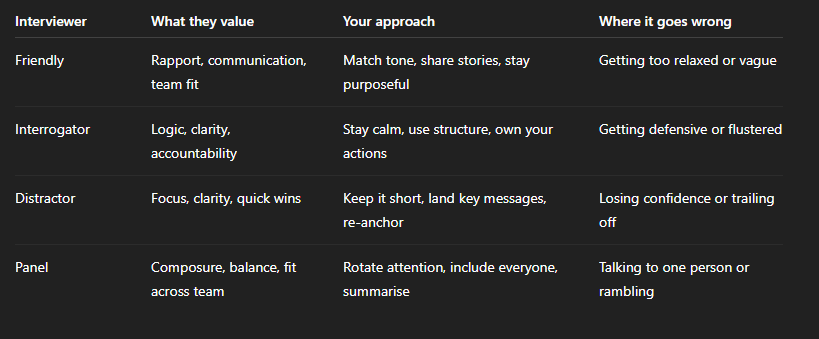
Here’s a quick snapshot:
Train the skill
Start paying attention in low-pressure conversations.
Who talks fast? Who pauses? Who interrupts?
How do they react when you slow down? Speed up? Ask questions?
Slight adjustments go a long way. And once you start doing this, you’ll never walk into an interview blind again.
It’s about Connection
The best candidates don’t just answer well. They connect well.
That’s what makes the difference.
You don’t need to be a mind reader. You just need to be present, pay attention, and adjust when you need to.
That’s what real interview prep looks like.
Want help with your job search?
Start with these free tools that thousands of jobseekers use every week:
- Download my free CV Template – the proven structure I use as a recruiter.
- Get instant feedback with the AI CV Reviewer – trained on 20 years of experience.
- Use the AI Interview Coach to get tailored questions and strong example answers.
- Explore the full Job Search System if you want a step-by-step plan to land more interviews.
If you want practical, straight-talking career advice every week, you can also join my newsletter here.